Most GEO Is Just SEO With a New Invoice
Published · By Tom Galland
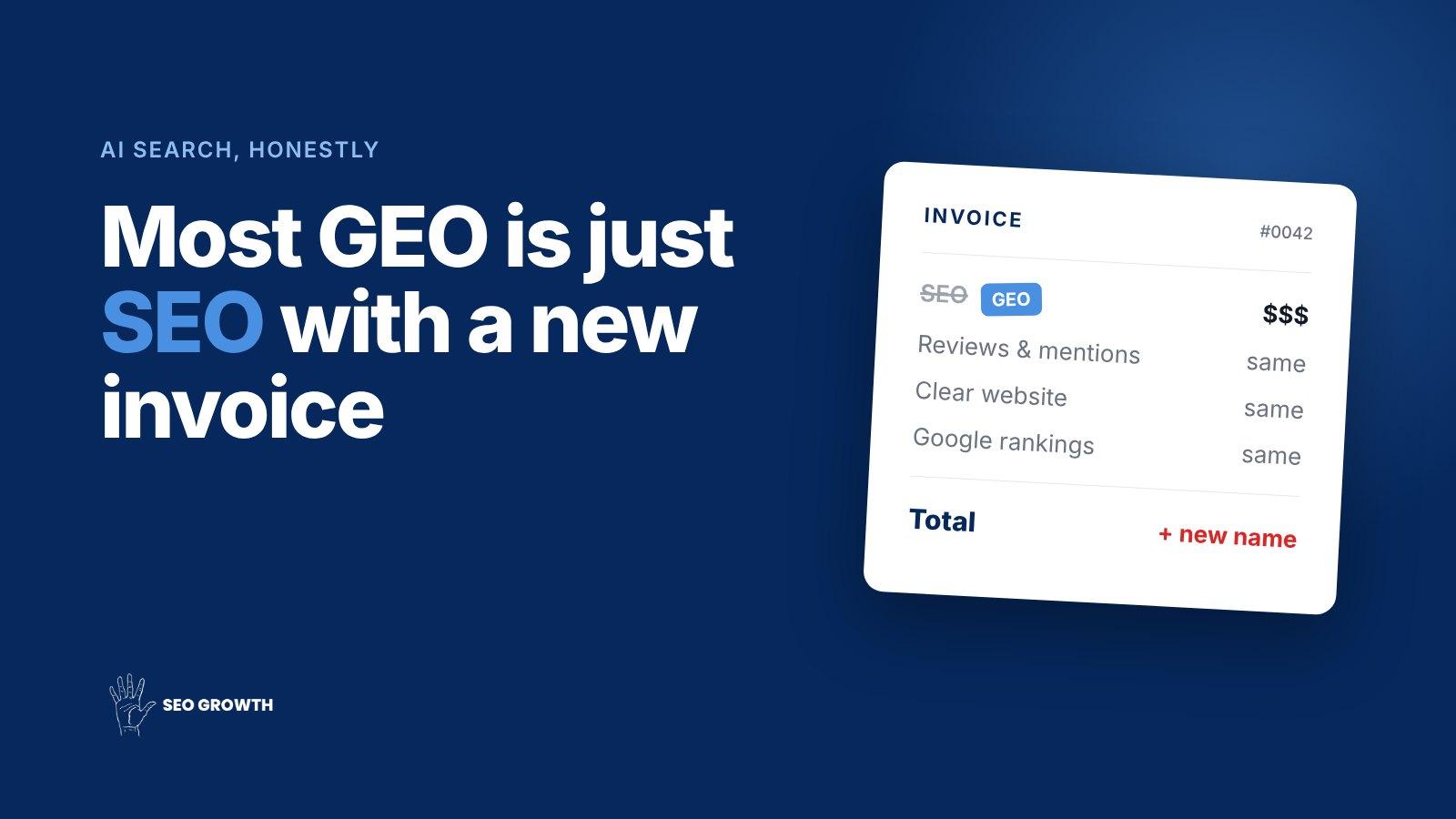
Every week someone new on LinkedIn becomes a "GEO expert". Usually it's the same person who was selling SEO, social or web design last year, with a new title and a bigger number on the quote.
My view is pretty simple. AI search is real and it matters. More people are asking ChatGPT, Gemini and Google's AI Mode who to call, what to buy and which business to trust. But most of what's being sold to small businesses as GEO (generative engine optimisation) is SEO with a new name on the invoice.
At SEO Growth our team works on SEO and Google Ads for businesses across Australia, and AI search is a big part of that work every day. We've even run our own Black Friday AI search study. So this isn't me telling you to ignore it. It's me telling you to be careful about who you pay to "do" it, and to know what you're actually buying. I've pulled together what OpenAI, Google and the bigger traffic studies are saying, because the data tells a much calmer story than the sales pitches do.
Why GEO pitches are so tempting
If someone tells you there's a new way to get your business recommended inside ChatGPT, and that your current agency is a bit "old school", it's tempting. Nobody wants to be the business that missed the next big thing. And when you're paying an agency every month and the leads aren't flying in, a fresh idea with a new name sounds like the answer.
The thing is, the pitch usually leans on fear and novelty more than evidence. Digiday reported earlier this year that a whole cottage industry of GEO vendors has popped up, with one WPP Media executive saying he gets a GEO pitch about once a day. Investors have put more than $227 million into AI visibility tracking tools. When that much money is chasing a new label, plenty of people are going to put that label on whatever they were already selling.
I think agencies end up on one side of the market or the other. One side sells the shiny new thing. The other side does the work that actually gets a business found, on Google and in the AI answers. We've picked our side, which is why AI search optimisation sits inside our SEO work rather than being sold as a separate product.
What has actually changed
The demand side of AI search is real, and it's growing fast. At an OpenAI event in New York last week, ChatGPT's consumer product lead Adam Fry said ChatGPT's volume of search-like queries is now roughly one fifth of Google's. He described those as the questions people used to take to a search engine, like looking up people, places and things, or finance and health questions where current information matters. In the same talk he said weekly users had grown from 1 billion to 1.2 billion in about 60 days.
Local searches are moving too. BrightLocal's 2026 Local Consumer Review Survey of 1,002 US adults found 45% now use ChatGPT and other AI tools for local recommendations, up from 6% the year before. Google is still the biggest source, but its share dropped from 83% to 71% over the same period. Those are US numbers, but in my experience Australian habits tend to follow pretty closely, which is why local SEO now has to cover the AI tools as well as Google Maps.
So people are clearly asking chatbots who to call. What's less clear is how many of them then click through to a website, and the traffic data is where the GEO pitch starts to wobble.
AI still sends very little traffic
Statcounter's referral data for August 2026 shows AI chatbots made up 0.25% of all search, social and AI referrals worldwide, and 0.16% in the US. Google alone sent 91.1% of search engine referrals. ChatGPT sends most of the AI traffic that does exist, at about 79% of AI chatbot referrals.
A separate study published on 8 November 2026 tracked more than 16,000 websites through Search Console and GA4. It found that for every 100 visits from Google organic search, AI assistants now send about 1.25. That ratio has almost doubled in a year, and AI referrals grew around 45% while Google organic clicks fell 15%. Even so, Google organic still sends roughly 80 times more visits than every AI assistant combined.
The authors make a fair point that these numbers undercount AI. App visits often show up as direct traffic, and clicks from Google's own AI Overviews are counted as normal Google traffic. But undercounted or not, the gap is huge. Anyone telling you to shift your budget away from Google and into "AI" is ignoring where your customers are still clicking.
Google says there is no special trick
Google has also been very direct about this. Its page on AI features says there are no additional requirements to appear in AI Overviews or AI Mode, and no special optimisation needed. To show up as a supporting link, a page needs to be indexed and eligible to appear in normal Google search with a snippet.
In May 2026 Google went further and published a full guide on optimising for its generative AI features. It says that from Google's point of view, optimising for generative AI search is optimising for the search experience, and so it's still SEO (Search Engine Journal covered it here). The guide says you don't need llms.txt files or other AI-specific files (Google ignores them), you don't need to chop your content into small chunks, and there's no special schema for AI. It also warns that chasing fake mentions around the web doesn't work as well as people think.
So both things are true at once. People are using AI to search, a lot. And there's no secret GEO trick that sits outside good SEO.
AI search still runs on SEO foundations
When you strip away the new acronyms, AI search rests on the same things good SEO has always been built on. I break it into three parts.
1. Trust and authority. Real reviews, real mentions and other websites talking about you. Ahrefs looked at 75,000 brands and found the number of times a brand is mentioned across the web had the strongest link to showing up in Google's AI Overviews, with a correlation of 0.664. Plain backlink counts came in much lower at 0.218. That doesn't mean links are dead, but it does show AI tools lean heavily on what the rest of the internet says about you. For a local business that means Google reviews, local press, industry directories, partners and suppliers mentioning you, and customers talking about you online. It's also why we treat link building as getting your name in the right places, not just collecting links.
2. A website that matches what people search for. Clear services, clear suburbs and clear answers. A study of 10,293 pages across ChatGPT, Perplexity and Google AI Mode found pages ranking in Google's top three were cited by AI 57% of the time, while pages in positions 13 to 20 were cited only 13.5% of the time. The author describes Google rankings as the gateway into the pool of pages AI picks from, with the content on the page deciding which ones get used. Pages that covered the question well, compared options clearly and backed things up with real numbers did better. That's just a well-written page, and it's the same reason some businesses seem to own every search in their area.
3. A new platform you have to show up on. This is the only genuinely new part. ChatGPT, Gemini, Perplexity and Google's AI Mode are new places your customers are asking questions. It's worth checking what they say about your business and your competitors, and working out why. We've written a practical guide on how to get mentioned in ChatGPT if you want to go deeper. But it's a new place to be found, not a new rulebook.
If you get the first two right, you've done most of the work for the third. Digiday quoted Jeremy Moser from uSERP saying the 80/20 of GEO is simply good traditional SEO, and that matches what we see with our own clients. The businesses that show up in AI answers are almost always the ones that already have strong reviews, a clear website and decent Google rankings.
Three questions to ask anyone pitching you GEO
Next time someone pitches you GEO, AEO or "AI search optimisation", ask them these three questions before you sign anything. They sit nicely alongside the questions to ask before hiring any marketing agency.
"What will you do that's different from good SEO?" A good answer should be specific. Maybe they'll check how AI tools describe your business, find the review sites and directories those tools pull from, and fix gaps in your website content. All of that is useful, and all of it sits inside good SEO. If they can't explain it clearly, or the answer is mostly a dashboard, be careful. Be especially careful if the plan involves pumping out dozens of AI-written articles or planting mentions of your business around the web. Google has said fake mentions don't work well, and Digiday found SEO experts warning that mass AI content can hurt your Google traffic.
"How will we know it's working?" You want enquiries, phone calls and booked jobs. A "visibility score" on its own tells you very little. AI tools don't share their data with anyone, so every tracking tool is modelling the numbers its own way, and two tools can give you two very different scores for the same business. In the Digiday piece, Lily Ray from Amsive said she'd seen GEO vendor case studies showing AI visibility going up while the same company's organic traffic fell, in one case by 66%. A score that goes up while your leads go down isn't a win. This is why we put lead tracking in place for clients, so every call and form can be tied back to where it came from.
"What happens to my Google rankings while you do this?" Google still sends the vast majority of website traffic, and the 10,000 page study above shows Google rankings feed directly into which pages AI tools cite. Anyone telling you to pull back on Google to focus on AI is taking a punt with your money. The right answer is that the work should help both.
Check your own foundations first
Before you pay anyone for AI search, spend half an hour checking the basics yourself. It won't cost you anything.
- Google your main service and your suburb, the way a customer would. Note who shows up in the map results and the first few organic results.
- Compare your Google reviews with the top three businesses that come up. Look at how many they have, how recent they are, and whether the owner replies. Our free Google Business Profile auditor can help with this.
- Read your homepage and ask whether a stranger would know exactly what you do, and where, within five seconds.
- Check you have a separate page for each main service, and for the areas you actually want work from.
- Ask ChatGPT and Google's AI Mode who they'd recommend for your service in your area. If they name competitors, look at what those businesses have that you don't. It's usually more reviews, more mentions, or a clearer website. Our free AEO scanner gives you a quick read on how AI-ready your site is.
If those foundations are weak, no GEO expert is going to fix it with a new acronym. If they're strong, you're already in a good position for AI search, and the extra work is about building on them, not starting again.
AI search is a genuine shift in how people find businesses, and we're spending a lot of our time on it. I just don't think the answer is a new type of agency or a new line on your invoice. It's the same work done properly, with an eye on a few new places your customers are asking questions.
If you've been pitched GEO and want a second opinion, book a 30 minute call with me. I'll tell you honestly whether it's worth it.
Tom
Sources
- OpenAI: ChatGPT search is about 20% of Google's, Big Technology, 3 November 2026
- 2026 Local Consumer Review Survey, BrightLocal
- AI Traffic Share 2026 (Statcounter data, August 2026), upGrowth
- AI Traffic vs Google Organic: 2026 Study of 16,000+ Sites, SEOcrawl, 8 November 2026
- AI features and your website, Google Search Central
- Optimizing your website for generative AI features on Google Search, Google Search Central, May 2026
- Google's new AI search guide on AEO and GEO, Search Engine Journal, 15 May 2026
- As AI search grows, a cottage industry of GEO vendors is booming, Digiday, 5 March 2026
- An Analysis of AI Overview Brand Visibility Factors (75K Brands Studied), Ahrefs
- Is GEO a Scam? 10,293 Pages Tested Across 3 AI Platforms, AI+Automation, April 2026
GEO and AI search FAQs
Is GEO just SEO?
Mostly, yes. Google says optimising for its generative AI features is still SEO, and studies show AI tools mostly cite pages that already rank well in Google. The genuinely new part is checking how AI tools like ChatGPT describe your business and building the reviews and mentions they rely on.
Do I need an llms.txt file or special schema to show up in AI Overviews?
No. Google's guidance says there are no additional requirements to appear in AI Overviews or AI Mode, that Google ignores llms.txt files, and that there is no special schema for AI. A page needs to be indexed and eligible to show a snippet in normal search.
How much traffic does ChatGPT send to websites?
Still very little compared with Google. Statcounter data for August 2026 shows AI chatbots made up 0.25% of search, social and AI referrals worldwide, and a study of more than 16,000 sites found Google organic sends roughly 80 times more visits than all AI assistants combined.
What should I ask an agency pitching GEO?
Ask what they will do that is different from good SEO, how you will know it is working (enquiries and calls, not a visibility score), and what happens to your Google rankings while they do it.
Ready to Rank Higher on Google?
Get a free SEO audit and discover exactly what's holding your website back from dominating search visibility.
✓ No 12-month lock-ins • ✓ Track your progress monthly in your own dashboard